What can I expect during my electrical apprenticeship?
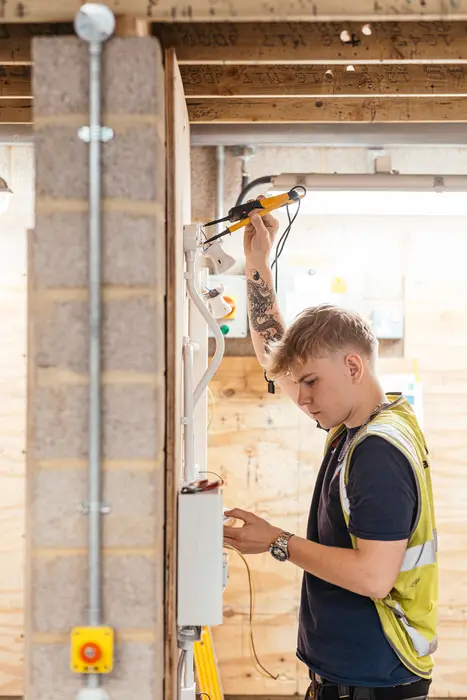
Nervous about starting an electrical apprenticeship? Don’t be! This article is designed to help you understand what to expect.
Every apprenticeship is unique, and that’s one of the great things about them. Each individual will gain unique experiences that help shape their future career. But that doesn’t mean that there aren’t also a lot of common experiences shared between apprentices – for example, there will likely be some crossover in the material covered in electrical apprenticeships and other Building Services Engineering (BSE) apprenticeships such as plumbing and heating. But more broadly, all apprentices will share more universal experiences, such as the balance between training and work life.
The GOV.UK site has put together a helpful page covering many of those overlapping experiences for apprentices, as well as addressing some of the most frequently asked questions about apprenticeships. It features lots of articles and videos from previous apprentices talking about what an apprenticeship has meant for them.
Your day-to-day life as an apprentice
The life of an apprentice is split into two parts, which can be broadly categorised as ‘learning’ and ‘earning’. Arguably the best part of an apprenticeship is the fact you can do both of these things in one week. Typically, this is managed by sharing your time between a college, where you’ll take part in classroom study, and your place of work, where you’ll perform your job responsibilities while applying what you’ve learnt in the classroom.
You’ll normally spend four days of the week at work, and only one day of the week at a college or learning centre. Apprentices are required to be on a minimum work contract of 30 hours per week, so this usually translates to an 80/20 split between earning and learning.
Your assessments and examinations
The main qualification you will receive upon completing your apprenticeship in England will either be the Level 3 Domestic Electrician apprenticeship or the Level 3 Installation and Maintenance Electrician apprenticeship*. Different systems apply in Wales, Scotland, and Northern Ireland, although there are significant similarities between them.
Your apprenticeship will be considered completed so long as you finish your college training and retain consistent employment for the duration of your electrical apprenticeship (usually three years). The final assessment you will have to complete is the AM2S (for the Installation and Maintenance Apprentice route) or the AM2D assessment (for the Domestic Electrician route), which is a practical test you will take at the end of your apprenticeship.
What you can expect in terms of salary and payment
All apprentices are entitled to a minimum rate of £7.55 an hour* in their first year of apprenticeship, regardless of age. However, once that year has been completed, and provided they are over the age of 19, they will be entitled to the minimum wage for their age bracket.
So, a 16-year old’s electrical apprenticeship wages will be at least £7.55 an hour. Meanwhile, an apprentice in their second year and over the age of 21 will receive an electrical apprenticeship salary of at least £12.21.
What happens at the end of your apprenticeship
Completing an apprenticeship is a fantastic thing for your career prospects. You may find that your employer wants to take you on as a full-time employee, or you may wish to apply for the ECS gold card in order to consider work at other workplaces or as an independent contractor.
Paul Collins, Technical Director at NICEIC, said: “The opportunities available to you after completing an electrical apprenticeship will seem exciting, robust and plentiful. Which is exactly what they are. It is a fantastic time to be newly qualified in a discipline of which the electrotechnical industry is in such vital need, and you will feel that need reflected in many employers’ openness to you.
“For employers looking to take someone on, an individual that has completed an apprenticeship shows clear-cut evidence that they are a hard worker with a thorough, fundamental grounding in electrotechnical principles and theory. On paper, you couldn’t be a better candidate for them.”
If you’re interested in reading more about what an electrotechnical apprenticeship journey can look like, you can read some of the in-depth case studies on the NICEIC website, which venture into more detail on past apprentices’ experiences:
Read more about:
Charlie Moore
Demi Whitehead
Jack Howes.
*As of April 2025